My mission is, as I call it, to help people find their ‘mojo’ and get their sparkle back, often during or after a difficult time.
I use my skills, therapeutic background and decades of corporate, private and third sector experience, to deliver consciously crafted, compassionate learning and facilitate meaningful change.
I started my therapeutic career more than two decades ago in bereavement, where my work included supporting people at Coroner’s Court, who had been bereaved by murder and suicide.
As part of my work today, I particularly highlight the impact of loss and trauma, and the importance of compassion-focused practices, to help people as I call it ‘find their mojo and get their sparkle back’.
I include in this work the dimension of spiritual health as a mechanism for healing, recognising how difficulty – and wisdom – can show up in our dreams and sleep.
To find out more about me click here, or for more information about the services I provide, take a look at these highlights or get in touch. For values and vision, keep reading.
Research now supports that lack of well-being – and particularly reduced spiritual health – can significantly impact individuals and communities, leading to loneliness, isolation and other difficulties including depression. There are a number of root causes and proximal factors that may influence this.
For example, a person may have been impacted by a traumatic event like bereavement, is experiencing “intolerable stress” (like a divorce) or may lack a sense of meaning or purpose. (This is why I make room for discussions around spiritual health (not necessarily religion) as an ingredient for healing, connection and helping people find their “why”.)
People may also be “time poor” (working all hours that leads to burnout) or have developed a mindset, habits or behaviours that keep them stuck.
Organisations and businesses can also unwittingly contribute towards this through poor workplace policy (like some sickness absence procedures), moral injury, or unhealthy attitudes towards wellness practices.
I also recognise how systems, societal narratives – and even workplace practices – can keep people silent, compliant and suffering. This means I also raise awareness of how, for example, coercive and controlling behaviours show up in the workplace, and how some “wellness initiatives” actually shame and blame, doing more harm than good.
Trauma-informed services also “take into account an understanding of trauma in all aspects of service delivery and place priority on the trauma survivor’s safety, choice and control.” (Becoming Trauma Informed, CAMH, 2012)
Below you can find statements in relation to my mission, vision and values with this in mind.
What’s My Why?
My work very much endorses a holistic model of working with people, and is influenced by people like Carl Rogers, Abraham Maslow and other humanistic and spiritual thinkers of their era, alongside Buddhist philosophy and researched insights on spiritual intelligence. In this context, humanism refers to the moral and philosophical enquiry of human potential, improvement and personal agency, as opposed to the non-theistic movement.
This creates dialogue about the importance of things like meaning, authenticity, self-awareness, spirituality, compassionate social action and self-transcendence as keys to well-being, or what Maslow described (in Toward a Psychology of Being) as “full-humanness”.
I strongly believe in the power of human potential and, through the extensive involvement I’ve had facilitating peer support, know that communities can work together to help create a peaceful and more enlightened society.
Vision – The What
To be a meaningful facilitator and consciously compassionate content creator and educator, thought-leader and luminary, who aims to improve the global conversation around what it means to “be well” and “live a good life”, that moves beyond “grind culture”.
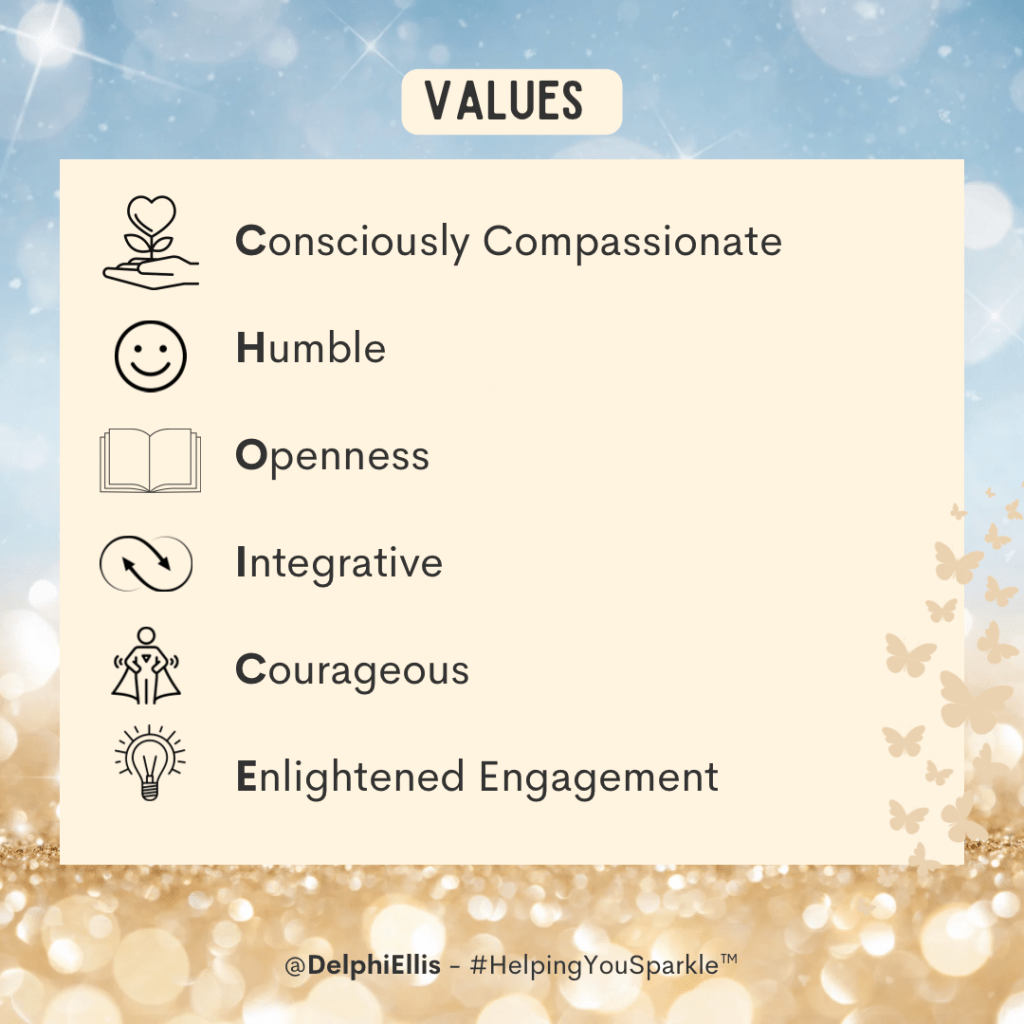
Values: The How
C-H-O-I-C-E
The energy of my work is intentionally driven by this vision, mission and my values and principles. As the focus of my work predominantly involves a female audience, for the purposes of clarity, that includes anyone who identifies as a woman or is affected by the unhealthy socialisation and cultural ‘norms’ (such as “good girls are quiet girls”) that impact women’s well-being.
I welcome healthy and meaningful dialogue from different communities around the world. However, any commentary deemed to be abusive will not be tolerated and will be reported.
Below are details of my values and principles. Based on my skills, training and experience, my audience is predominantly women at this time.
Consciously Compassionate – To work with those impacted by hate and harm in a way that holds space in a non-judgemental and meaningful way.
To work authentically with people, and within my remit. To remain self-aware of my own biases, life experiences and “window of the world” and to be intentional in my interactions with others. ie To say what I mean and mean what I say.
Humble – To recognise that learning is a life long endeavour and that, while no one knows it all, through my skills, training and experience I may be able to offer insight and inspiration.
To stay up to date with current research and knowledge, to provide an accurate representation of therapeutic methods, always seeking to provide an honest reflection of how I can help.
Openness – To be transparent in conversation, as far as is possible, and to hearing differing views when discussing difficult topics.
To be clear about what I can (and can’t) do to help. To emphasise that information provided through my services should never be used to replace the advice of your healthcare or legal team. (See policies for more details).
Integrative – To explore well-being from a holistic perspective, that considers wellness as a broad category (ie not just physical or mental health) and can include a range of options (ie not just therapy).
To recognise that everyone is different and that there is not a “one-size-fits-all” approach to healing.
Courageous at the moral level – To be patient in interactions with others as far as is possible but to challenge opinions and narratives that perpetuate myths about violence, particularly towards women.
To not tolerate any form of abuse including insidious communication such as ghosting and gaslighting.
To engage in compassionate social action as appropriate and where possible, to facilitate meaningful change.
To be consciously aware of systems that create dominance and control, which can influence beliefs (including a false sense of entitlement) and therefore immoral behaviour, both at an individual and organisational level.
Enlightened Engagement – To open conversations which provide compassionate education, knowledge and insight that will help achieve this vision and mission statement, and to enable others to draw on their own strengths which empower healthy conversations that encourage positive change.
To be mindful of and embrace our differences and encourage togetherness through meaningful conversation, and be aware of how struggles and difficulties can often intersect. To know that true collaboration means bringing people together to hear their voices, sharing awareness and experiences, but without subjecting them to further harm. As far as is possible, this also includes being intentional in decision making and responsive (rather than reactive) to people’s needs.
There are many important causes which need time and attention and where those needs exist that are not represented here, I encourage those communities to establish, within reason and remit, services/campaigns/movements/projects as appropriate.
As a pacifist, I also welcome dialogue which seeks to end violence across our global community, through collective care, meaningful collaboration, and non-violent communication.
To embrace spirituality as an important ingredient to holistic health to enable self-transcendence to a “good life” that recognises and supports our interrelatedness.
Delphi is the author of Answers In The Dark: Grief, Sleep and How Dreams Can Help You Heal, out now on Amazon and Hive. Monday Mojo™ is not affiliated with any other newsletter or podcast that may have the same name.All content is © Delphi Ellis, all rights reserved. All services are subject to availability. Please read these policies for details.
 Helping You Sparkle™